Pre-Emergent Timing in Georgia
Super-Sod recommends applying pre-emergent herbicide to Georgia lawns three times a year in winter, spring, and early fall, based on the soil temperature in your area. In this article, we explain the ideal timing and soil temperature, plus offer a chart and other resources to thoroughly explain when to apply pre-emergent in Georgia.
First, let's define "pre-emergent." Pre-emergent herbicides are applied to Georgia lawns to prevent weed seeds from fully germinating. The root germinates first, and when it touches the pre-emergent barrier, it is killed. Killing the root causes the rest of the seed to die because it doesn't get the nutrition it needs to help the shoot germinate. Weeds are killed by pre-emergent herbicides during the germination stage, so you never even see them.
When to Apply Pre-Emergent in Georgia
Apply pre-emergent herbicide to Georgia lawns in February, April, and September. Some lawns are sensitive to frequent herbicide applications, so Super-Sod recommends following this schedule based on your lawn type.
| Grass Type |
February Pre-emergent |
April Pre-emergent | September Pre-emergent |
| Bermuda | Yes | Yes | Yes |
| Zoysia | Yes | Yes | Yes |
| Centipede | Yes | Skip this application | Yes |
| St. Augustine | Yes | Skip this application | Yes |
| Tall Fescue | Yes | Yes | Skip this application if planting Tall Fesuce seed in the fall |
Note: Do not apply pre-emergent herbicide if you plan on laying new sod or planting seed in 3-4 months. Pre-emergent not only inhibits weed seeds from germinating, but it also inhibits all seeds and new sod roots from growing until the pre-emergent wears off. Likewise, don't apply pre-emergent to new sod until it's fully rooted in and no seams are visible, usually after one growing season.
Winter and Spring Pre-Emergent Timing in Georgia
The winter and spring pre-emergent applications are relatively close together to prevent summer weeds: February and April are the first months to apply pre-emergent in Georgia.
Keep in mind that ground temperature is critical for the performance of your winter and spring pre-emergent applications.
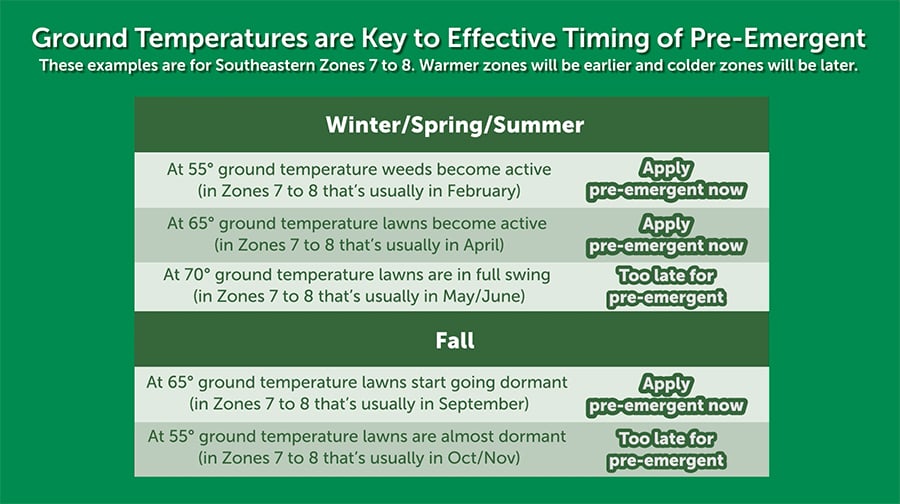
In February when ground temperature rises to 55°, that's when summer weeds start germinating in Georgia. In particular, crabgrass has been proven to germinate as early as February. If you have a crabgrass infestation, this winter application is critical.
When ground temperature reaches 65°, your lawn wakes up, and summer weeds germinate too.
When ground temperatures reach 70°, your lawn is in full swing. It's also too late to spread pre-emergent for effective control of weed seed germination.
We grouped the February and April applications in the same section because it's important to understand that the April pre-emergent application is the second half of a two-part treatment - the February application being part one. The second April application works best in tandem with the first, so please note that if you didn't spread pre-emergent in February, and are only spreading in April, that you'll still see some summer weeds, such as crabgrass. Think of the April application like it's a booster shot.
Note: If you have a Centipede or St. Augustine lawn, we recommend skipping the April pre-emergent application, and only applying twice a year - in February and September. We recommend this schedule because Centipedegrass and St. Augustinegrass are particularly sensitive to chemicals.
Fall Pre-Emergent Timing in Georgia
In the fall it's exactly opposite as described for winter and spring. Instead, apply pre-emergent when your ground temperature lowers to 65° (and before it lowers to 55°). That's usually in September in Georgia. Winter weeds become active in that ground temperature window, and pre-emergent will prevent weeds so you don't see those weeds through next spring. This September application is especially effective at controlling annual winter weeds such as Poa annua, hair bittercress, chickweed, and henbit.
For the fall September pre-emergent application in Georgia, Super-Sod recommends 16-4-8 + Pre-emergent for Tall Fescue. Note: If you plan on planting Tall Fescue seeds, skip this fall pre-emergent application.
We recommend 0-0-7 + Pre-emergent for all warm-season lawns, such as Bermuda, Centipede, Zosyia, St. Augustine.
Why Soil Temperature Matters for Pre-Emergent Timing in Georgia
Because weed seeds germinate based on soil temperature rather than the calendar (as previously explained), Super-Sod recommends following ground temperatures in your area, rather than a stick-by-the-calendar playbook. However, adding notes to your calendar in February, April, and September is a good way to help you remember to look up your local ground temperature.
You can look up ground temperatures for your area of Georgia here on the UGA Weather Network. You don't need to buy a soil thermometer and track it yourself!
The following tables list the target ground temperature for the February, April, and September pre-emergent applications in Georgia.
| Pre-emergent Month: |
February |
April | September |
| Target Soil Temperature: | 55 degrees F | 65 degrees F | 65 degrees F |
FAQ About Pre-Emergent Timing in Georgia
I am about to install new sod, can I apply pre-emergent beforehand to stop weeds?
Don't apply pre-emergent if you will be laying new sod in the next 3-4 months. Pre-emergent not only inhibits weed seeds from germinating; it also inhibits new sod roots from growing until the pre-emergent wears off.
I recently installed new sod, is it safe to apply pre-emergent?
For the same reasons as in the previous question (pre-emergent kills new sod roots too), don't apply pre-emergent to new sod until it's fully rooted, no seams are visible, and the new lawn has been mowed 3-4 times - usually after one growing season.
I am about to install plant grass seed, can I apply pre-emergent beforehand to stop weeds?
Don't apply pre-emergent if you will be planting seed in the next 3-4 months. Pre-emergent not only inhibits weed seeds from germinating; it also inhibits seeds from germinating until the pre-emergent wears off.
How long will pre-emergent last in Georgia?
Pre-emergent will last for 6 to 12 weeks in Georgia, depending on climate conditions. For example, if it's very rainy, pre-emergent will be diluted and not be as effective.