

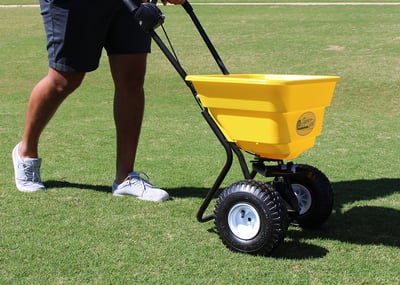
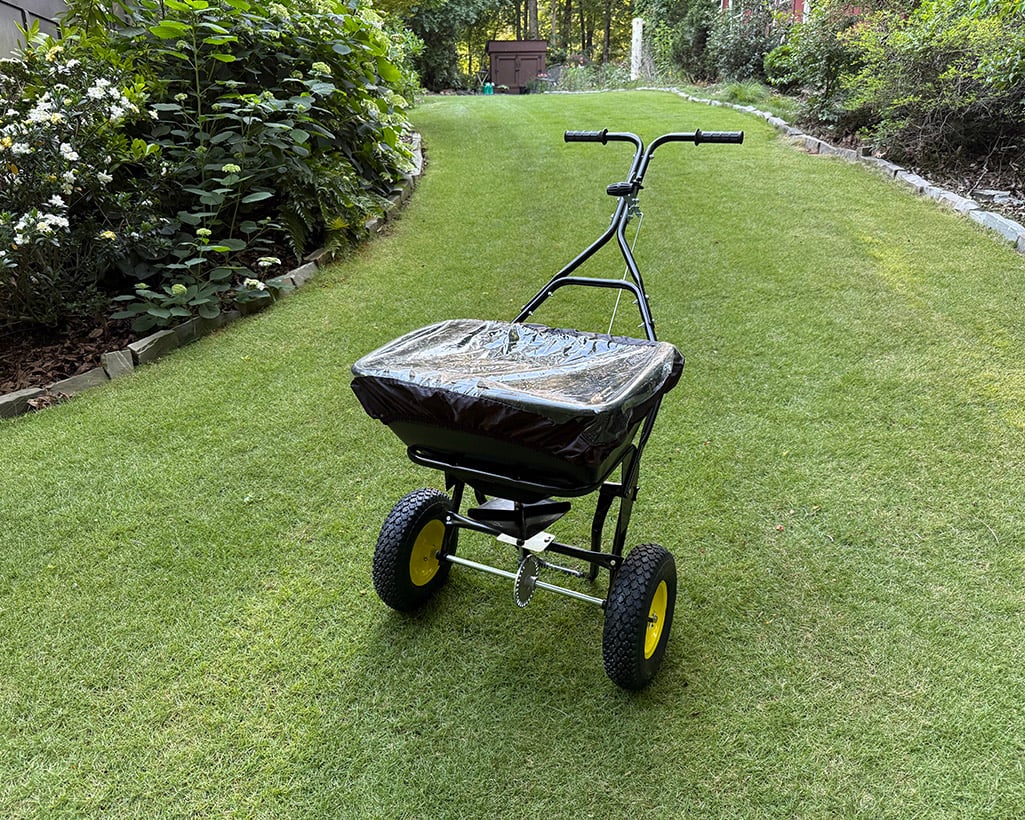

Lawn spreaders distribute granular lawn care products evenly and thoroughly across a lawn, providing reliable coverage. Spreaders make it easy to apply products and prevent over-application and waste.
Any granular product can be applied with a lawn spreader, such as fertilizer, pelletized lime, grass seed, wildflower seed, ice melt, and pesticides such as fungicides, insecticides, and herbicides.
However, a miscalibrated lawn spreader is a waste of your time and resources and improper application of lawn care products can negatively affect your lawn.
You've come to the right place to get your spreader settings right!
In this article, we provide a starting point for configuring settings on Super-Sod's commercial-grade broadcast lawn spreader. Then we explain how to calibrate other spreaders to get their settings adjusted for any granular product.
Our Lawn Spreader Settings
We have our own broadcast spreaders for use with our products or any other granular lawn care product. While it is a professional, commercial-grade spreader, it's also designed for home use.
The following settings are only a starting point and adjustments will need to be made based on your own unique walking pace as we explain further down in the "How to Calibrate Lawn Spreaders" section.
Black Spreader Settings |
||
| Fertilizer | Rate | Setting |
| 5-10-30 + Iron | 4 lbs./1,000 sq.ft. | 26 |
| 16-4-8 + Iron | 4 lbs./1,000 sq.ft. | 26 |
| 18-24-12 + Iron | 4 lbs./1,000 sq.ft. | 26 |
| Pre-Emergent | Rate | Setting |
| 0-0-7 + Pre-Emergent Herbicide | 4 lbs./1,000 sq.ft. | 26 |
| 16-4-8 + Pre-Emergent Herbicide | 4 lbs./1,000 sq.ft. | 26 |
| Fungicide | Rate | Setting |
| Professional Grade Fungicide (such as Strobe+ G) |
2-3 lbs./1,000 sq.ft. | 23* |
| Insecticide | Rate | Setting |
| 5-10-30 + Acelepryn Insecticide | 4 lbs./1,000 sq.ft. | 26 |
| 5-0-15 + Larvashield Insecticide | 3.4 lbs./1,000 sq.ft. |
24 |
| Broad Spectrum Insecticide (such as Talstar)** | 5 lbs./1,000 sq.ft. | 23 |
| Soil Amendment | Rate | Setting |
| Fast Acting Lime | 6 lbs./1,000 sq.ft. | 26 |
| Seed | Rate | Setting |
| Elite Tall Fescue - overseeding: make 2 passes to reach 5 lbs/1,000 sq.ft. | 2.5 lbs./1,000 sq.ft. | 30 |
| Elite Tall Fescue - new lawn: make 3 passes to reach 8 lbs/1,000 sq.ft. | 2.5 lbs./1,000 sq.ft. | 30 |
|
|
||
The settings listed are intended for general reference only for our commercial-grade spreaders. This reference list doesn't apply to settings for other spreader brands.
The setting numbers listed should be used as a starting point with adjustments made based on each user’s height, walking speed, and machine; for any hand-held spreader, it also depends on how fast the handle is turned and how high the spreader is held.
Spreaders can wear and fertilizers change density over time, so always double-check your settings. Super-Sod makes no warranty to the uniformity of coverage and cannot be held responsible for misapplication or damage caused by the products listed. Products we offer may change and be replaced in this list.
How To Calibrate Lawn Spreaders
Due to different human heights and walking speeds, it's important to calibrate a lawn spreader to your own pace. Keep in mind that if you're tall and a fast walker, you may need to adjust the setting to a larger opening so that a little more product is broadcast or dispensed at a time. (Likewise, if you have shorter legs or are a slow walker, you might need to close the opening a little bit so less goes through at a time.)
The calibration technique is simple, even though it does involve a test run on your lawn. Using Strobe+ G (lawn fungicide) as an example . . .
- Calculate how much product you will need:
- Measure how many square feet the total lawn area covers.
- Determine the application rate for the product - how many pounds per 1,000 square feet.
- For this example, the recommended application rate for preventing fungus is 2 lbs. of Strobe+ G per 1,000 square feet.
- Do the math: If a yard is 3,000 square feet, you need to apply 6 lbs. of Strobe+ G. (the math: 3,000 sf. x 2 lbs. per 1,000 sf. = 6 lbs.)
- Perform a 1,000 square foot test to determine the spreader setting:
- Measure out a 1,000 sf. area of the yard to apply the product for your initial calibration test.
- Measure out how many pounds of lawn treatment product are needed. You can use a kitchen scale or stand on your bathroom scale with a bucket of lawn product, and then subtract your weight with just an empty bucket.
- Close the opening of your spreader to allow just enough of the product to pass through. You don't want to apply too much to one area. The opening size really depends on the granule size of the product being spread. Since Strobe+ G is a fine granule, you'll want just a slight opening. Another example is our 16-4-8 fertilizer, which is a larger granule, so you'll want the opening to be a bit wider to allow the product to pass through.
- Apply the product to the 1,000 sf. test area.
- Adjust the spreader setting:
- Is there any product left in the hopper after completing your pass over the 1,000 square feet? If so, you will need to go over the area again to disperse the remaining product.
- Now you will have a feel for how much more you can increase the opening in the hopper of your spreader to apply the remaining product that you measured out for the rest of your yard.
- If you ran out of product before you completed the 1,000 square feet test, then reduce the size of the opening.
- Record your final calibrated settings:
- After you calibrate for and apply a granular product, make a note so the next time you apply it, you'll have your setting already. Make sure to note the product name and the corresponding number setting on your spreader.
- Record the information in your phone, hang it on a note board in your garage, write on a piece of tape you stick directly on your spreader – whatever method works for you.
The lawn spreader calibration process sounds tedious, but give it a go, and you'll find it's straightforward, and it becomes easier after doing it only once. (It's a good "real-world" math problem for kids to help you solve.)
Application Tip: Make 2 Half-Rate Spreader Passes
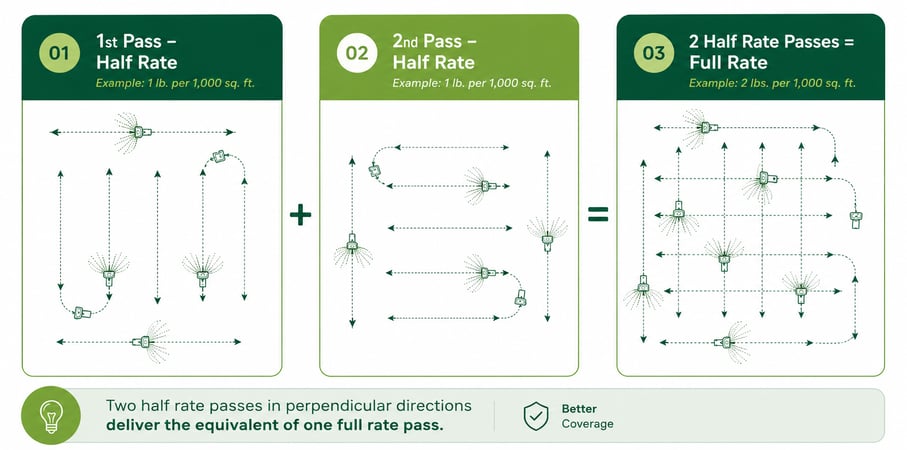
Once you determine your lawn spreader settings, the best practice to ensure even coverage on your lawn is to apply products in two passes:
-
The first half is applied in the north-south direction
-
The second half is a pass going east-west
Once you know your spreader settings, make sure you apply half the total recommended amount of lawn treatment product per pass. In other words, reduce the spreader setting for half of the recommended product application rate. Drawing from the calibration examples above:
-
When spreading 2 lbs. of fungicide per 1,000 sf., adjust the spreader setting by half to apply 1 lb. per 1,000 sf. going north-south, then the remaining 1 lb. going east-west.
-
When spreading 6 lbs. of fungicide to a 3,000 sf. lawn, adjust the spreader setting by half to apply 3 lbs. in one direction (north-south) and the other 3 lbs. in the opposite direction (east-west).
Two half-rate passes with a lawn spreader ensure uniform coverage of your lawn care products, as shown in this diagram.
Avoid Cheap Lawn Spreaders
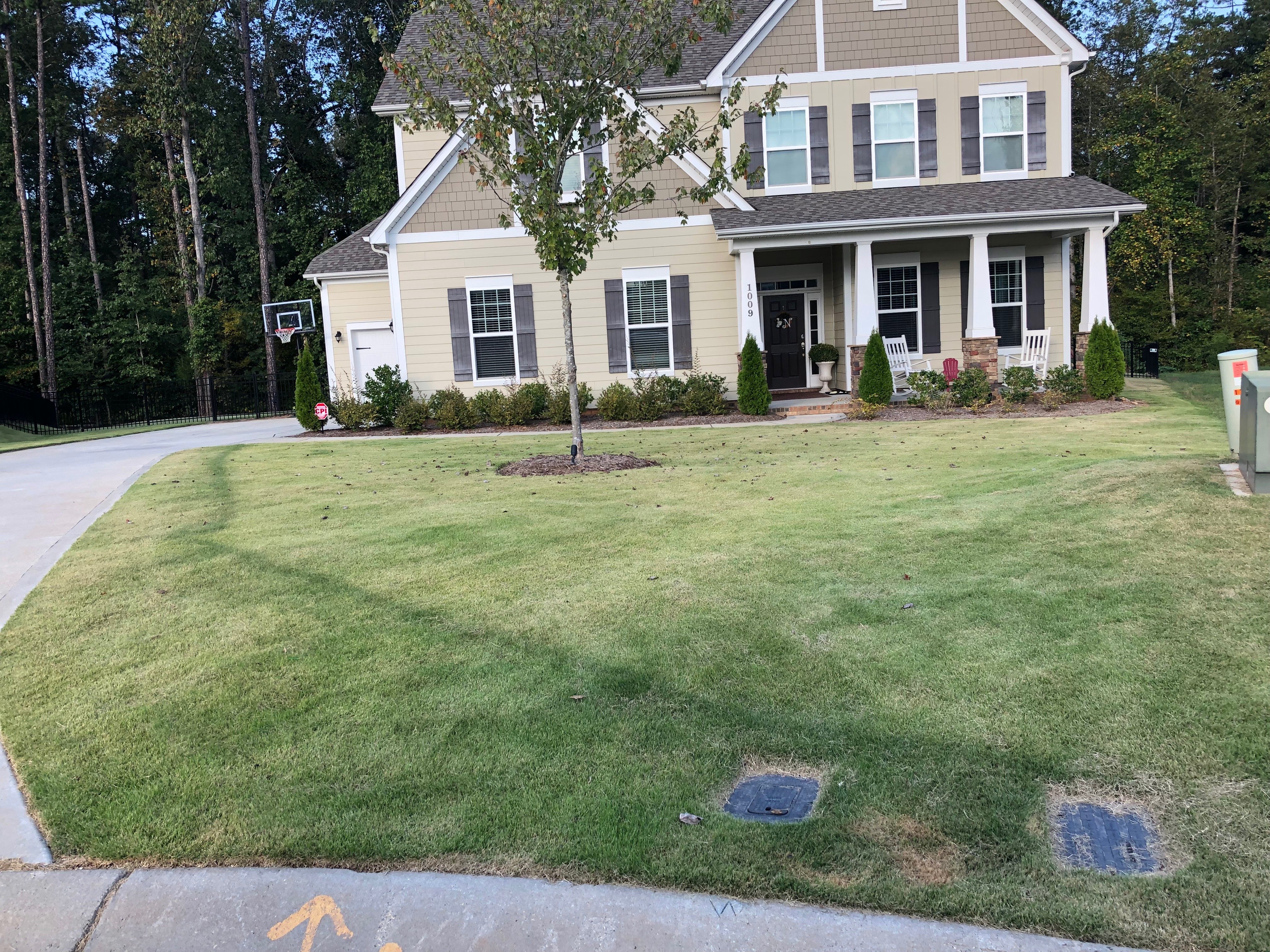
Like a miscalibrated lawn spreader, a cheap or faulty one is a waste of your time and can damage your lawn.
This picture shows how a faulty spreader spat out fertilizer only once per revolution, as shown by the rich green line on one side. The entire path should be rich and green. Thankfully, this person recognized something wasn't working right and quit after one pass.
Choose Super-Sod's Lawn Spreader
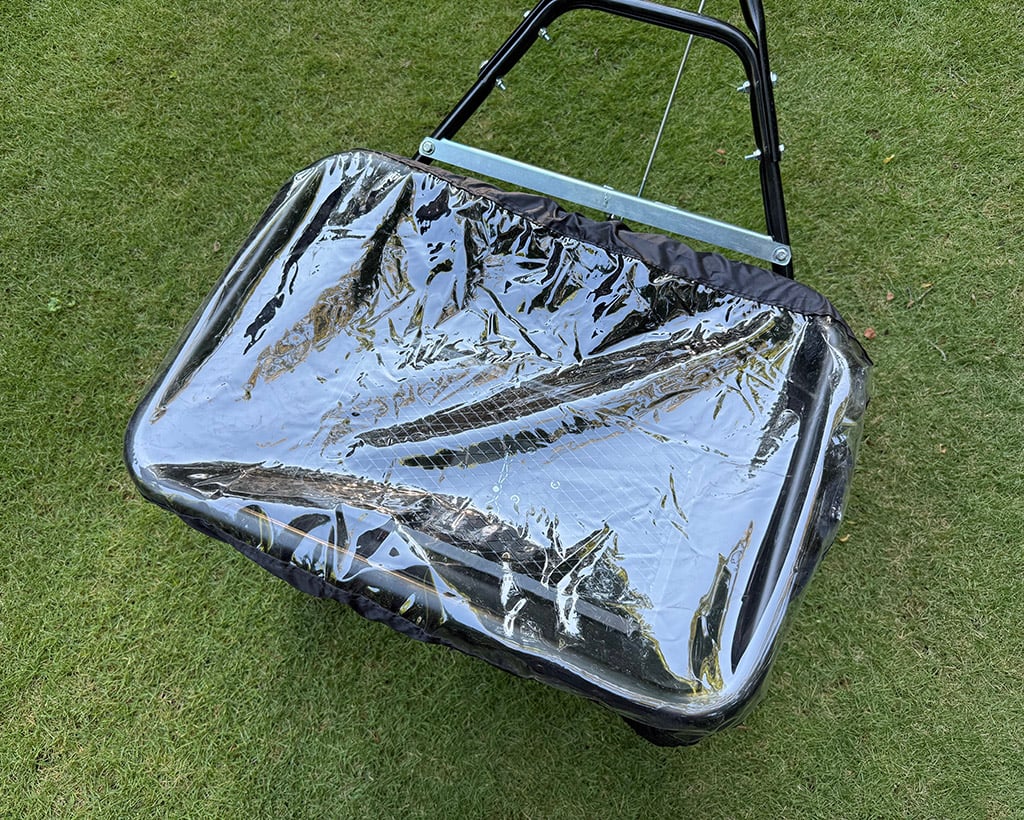
Our commercial-grade lawn spreaders are available at all Super-Sod stores and can be ordered online for pick up or delivery. Features include: 80 lb. capacity, hopper cover, 8-12 foot coverage, easy handling, and durability.

Other product resources:
- Look up product recommendations and application schedules for your lawn type in our Maintenance Guides.
- Subscribe to our Monthly Lawn Tips email for all the info you need to grow the lawn of your dreams!
Now that you know more about lawn spreaders than you ever thought possible, you're a pro on this topic. Help "spread" the word about quality spreaders and proper calibration by sharing and bookmarking this page for future reference.
Still have unanswered questions? Please ask them in the comments below!